ANTIQUARIAN, EDUCATOR, HISTORIAN
Situated in the Unconsecrated/East Section of Jesmond Old Cemetery
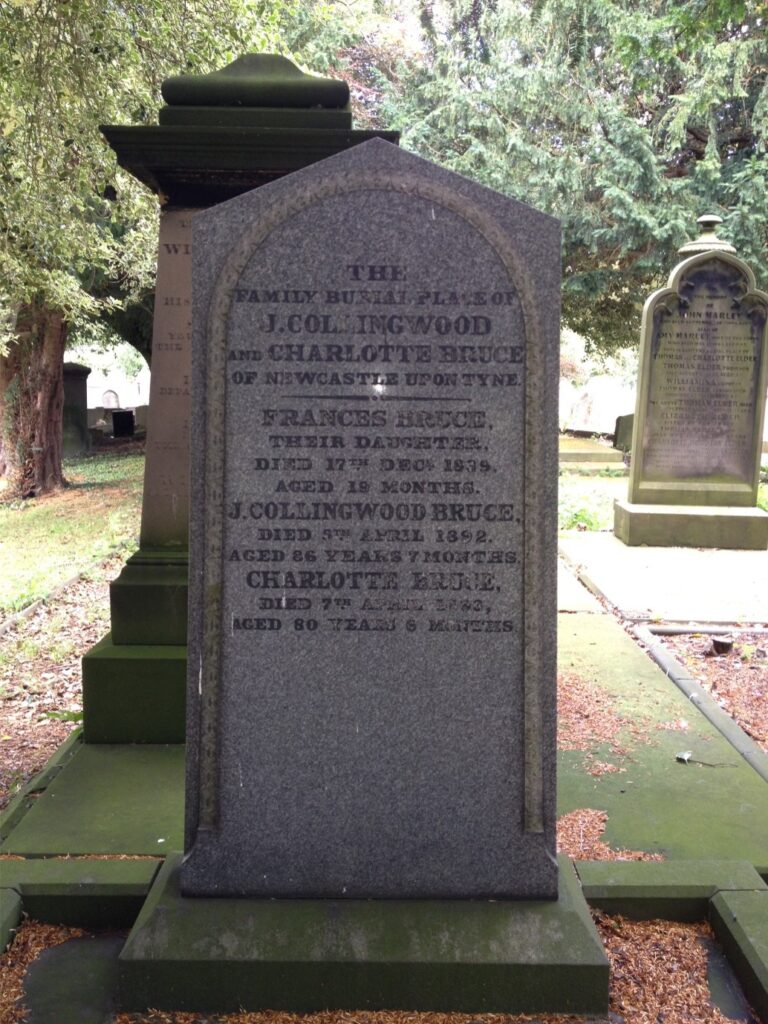
John Collingwood Bruce.
According to his son, Sir Gainsford Bruce, John Collingwood Bruce’s life (1805-1892) was one ‘not marked by stirring incidents, but occupied in scholastic duties, in quiet and unostentatious literary and antiquarian research, and in the earnest endeavour to extend the influence of religion and philanthropy.’ He is best known as an eminent local historian and antiquarian and particularly celebrated for his work on Hadrian’s Wall.
John Collingwood Bruce was born on 15 September 1805 in the house of his parents, John Bruce (1775-1834) and Mary (née Jack) (1782-1872), at 14 Albion Place, which later became 44 Leazes Park Road. Collingwood Bruce was, somewhat appropriately, a Sabbath day child and the apparent commotion that accompanied his birth is said to have resulted in the joint of veal that was roasting over the fire for that Sunday’s dinner to be forgotten and ruined. He was married to Charlotte Gainsford in the village of Chalfont St Peters, Buckinghamshire, on June 20 1833, with the eldest and most notable of their four children, Gainsford, being born on 24 May in the following year. Gainsford, who became a high court judge and member of parliament and received a knighthood in 1892, was followed in May 1838 by his sister, Frances, who died a year later, and then by another sister, Williamina, in May 1840. The couple’s final child was another son, John, born in October 1855.
Collingwood Bruce’s scholarly nature was surely influenced by his parents’ own intellectual endeavours. Both taught at Percy Street Academy, which John Bruce established in 1806 and acted as the principal schoolmaster whilst Mary oversaw the development of the youngest boys. Despite lacking a classical education, John Bruce was admired by his son for his self-trained abilities in teaching mathematics, geography and astronomy. Perhaps the most notable of the elder Bruce’s pupils was one Robert Stephenson, who expressed his gratitude for the education provided to him at the Academy in a letter to the younger Bruce in December 1839. An initial note of congratulations sent to the famed engineer upon the completion of the London and Birmingham Railway elicited the reply: ‘Your letter… revived the recollections of our earlier days, and above all it reminded me of your worthy and esteemed parent to whom I owe so much; indeed, it is to his tuition and methods of modelling the mind that I attribute much of my success.’
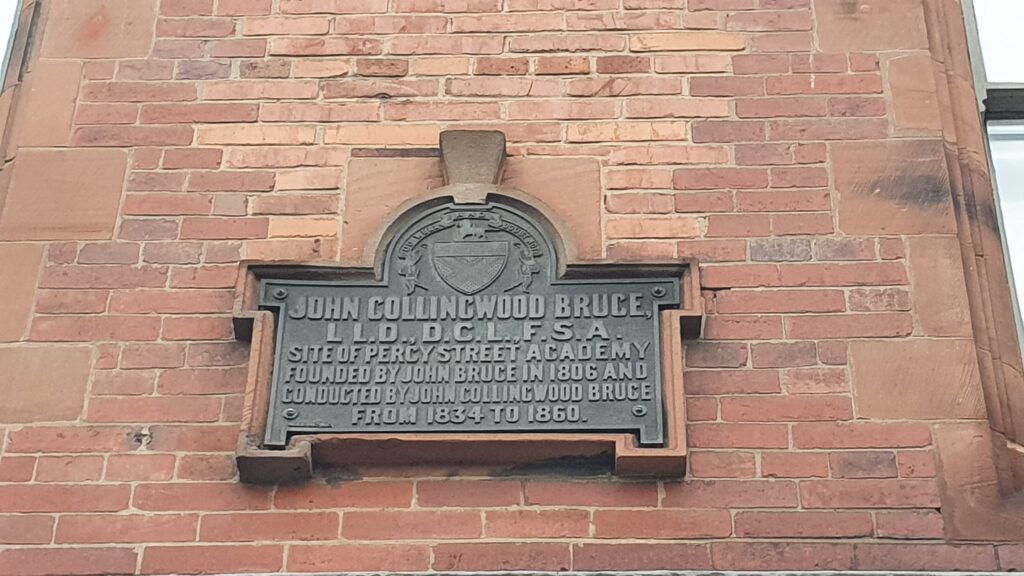
The plaque on the wall of Seekers Estate Agents on Percy Street, commemorating the Percy Street Academy.
To further his education Collingwood Bruce was enrolled at Mill Hill School in London at the end of 1818, boarding there until the summer of 1820. This time was clearly held dear throughout his life as he became president of the Old Millhillians Club in 1885 and wrote in glowing terms of his time there for the school magazine in 1888. In October 1821 he entered Glasgow University, attending classes in Humanity, Greek and Moral Philosophy before graduating with a Bachelor of Arts degree in 1825. Over the course of the following academic year Collingwood Bruce studied to attain a Master of Arts degree, taking classes in Mathematical and Natural Philosophy and completing in April 1826. In the interim period between studies for these two degrees he took his first theological studies, enrolling as a student at the Divinity Hall of the Secession Church. He pursued these studies over the following years, whilst also following lectures on Political Economy, Surgery, Anatomy, Hebrew and Chemistry, concluding them in autumn 1829. That November, the Newcastle Presbytery granted Collingwood Bruce license to preach, which he did to congregations across the north east of England and Borders of Scotland over the following two years. Some forty-three years after his enrolment as a student in Glasgow, the university bestowed upon him the honorary degree of Doctor of Laws – an honour not meted out to another scholar of archaeological remains until 2008. Appropriately, the recipient of this more recent honour, Professor David Breeze, edited the fourteenth volume of Collingwood Bruce’s Handbook to the Roman Wall, which is still the de facto academic guide to Hadrian’s Wall.
Collingwood Bruce began helping his father in the running of the Percy Street Academy during the intervals of his time at college before committing permanently to its co-management in 1831. This decision was taken after much deliberation on whether to relinquish his career as a minister and seems to have been motivated by a sense of family loyalty. Upon his father’s death, on 31 October 1834, Collingwood Bruce took sole charge of the school, moving with his wife and the young Gainsford to take up residence in its premises, where they lived for twenty-five years.
Collingwood Bruce’s passion for English history was in part fuelled by the importance that he placed upon it in the Percy Street curriculum. He was keenly aware of the value of what is now referred to as the historic environment – the buildings, monuments and landscapes which physically testify to the events of the past and ensure their immediate resonance in the present – and sought to imbue this into his pupils. Collingwood Bruce reminisced in later life about his efforts to simultaneously educate himself and his pupils in historic architecture through field survey:
‘I took my boys along with me in my inquiries. We visited together the principle architectural structures in the north of England, Jarrow, Tynemouth, Durham, Hexham, &c., and learnt to distinguish the Norman from the early English, the decorated, and the perpendicular.’
Such pursuits led Collingwood Bruce to deliver his first series of lectures on castellated architecture to the Literary and Philosophical Society in 1847, having presented a successful lecture on Gothic architecture to the same group in 1845. During this period he devoted much of his spare time to visiting and studying castle sites around Britain and Normandy and recognition of his expertise was reflected through his appointment by the Society of Antiquaries to a sub-committee charged with seeking appropriate means of restoring Newcastle’s Castle Keep. Collingwood Bruce also published a Guide to the Castle of Newcastle upon Tyne in 1847, by which time the keep and garth were in a poor state and at increasing risk from railway developments. In the following year, however, the Society of Antiquaries was granted a lease by the town Corporation for the Castle Keep at a token rate of 2s. 6d. per annum and money was made available for renovations. In celebration of these developments a banquet was held in the great hall on 3 August 1848, attended by the fourth Duke of Northumberland. The Duke was patron of the Society of Antiquaries and his presence at the banquet signalled the beginning of a friendship with Bruce, whose work he much admired and supported until his death in 1865. On the following day the building was opened to the public, with Collingwood Bruce delivering a lecture and the proceeds from entry charges contributing to the ever-growing restoration fund. This process laid the foundations for the Society of Antiquaries to be granted tenancy of the Black Gate in 1883, from which time renovation work was commissioned and collections were housed. Collingwood Bruce also gave a series of lectures in 1876 on the history of Newcastle and its inhabitants, projecting the hope that “long may the old keep stand to tell us the state of Old Newcastle in the twelfth century”.
In the years immediately following 1848 Collingwood Bruce committed a great deal of time and endeavour to studying Hadrian’s Wall, producing the first edition of his seminal text in 1851. A holiday in Normandy in the same year included a visit to Bayeux, however, where he encountered the famed Tapestry. This stimulated a new intellectual interest and initiated a chain of events that would ultimately lead to the rediscovery of an all-but-forgotten paper facsimile on the walls of the Black Gate in May 2013. Upon viewing the 70 metre long Tapestry (which, technically, is actually a work of embroidery) Collingwood Bruce felt inspired to write ‘one lecture, certainly not more than two’ for the benefit of the Literary and Philosophical Society. Ultimately, however, he produced a series of five lectures on the Conquest and Tapestry, delivering them in January and February of 1853 with the accompaniment of a full-scale replica of the Tapestry to illustrate. A book on the subject (the first to be completed in English), The Bayeux Tapestry Elucidated, was completed in 1855. This text further propagated the (since-undermined) legend that William the Conqueror’s wife, Matilda, commissioned the Tapestry and that the ‘needle of the high-born dame’, together with those of her ladies, executed the embroidery. In his preface, Collingwood Bruce acknowledged Charles Stothard’s ‘beautiful copy of the Bayeux Tapestry’, a drawing commissioned by The Society of Antiquaries of London and made over the course of 1816-17. It is presumed that Stothard’s engraving was used as the basis from which the pupils at Percy Street Academy produced a full-scale facsimile at their schoolmaster’s behest – one wonders how much time was taken away from studying in order to manufacture the full-scale copy! John Moffat, a pupil at the school from 1850 to 1852 and David Livingstone’s brother-in-law, was the principal draughtsman. The pen and ink drawing was made on paper and filled with watercolours and actually slightly taller in places than the original Tapestry. The Newcastle reproduction was faithful to the original design with exception to the odd lewd depiction. Such images must have agitated the Victorian sensibilities of the Reverend schoolmaster, who perhaps thought it inappropriate for his boys to view and copy any ‘adult’ detailing. Bruce and the facsimile travelled widely around England, Scotland and France both together and independently over the following years, particularly as a result of the interest stirred in Mark Anthony Lower (1813-76), a fellow schoolmaster and antiquarian, and the Sussex Archaeological Society, of which Lower was a founding member of in 1846. Collingwood Bruce and Lower lectured on the subject of the Conquest together and provided alternative views to the accepted narrative of the Norman Yoke, although with some contrast in their interpretations.
Collingwood Bruce donated his facsimile to the Society of Antiquaries in 1884 and in 1909 it was mounted as a frieze around the Library in the Black Gate, above the bookcases. Sadly, over the years the bookcases were extended upwards, hiding sections of the frieze, which became very dirty due to the atmospheric pollution from the railway and probably not considered very important. What was visible was taken down in the early 1960s when the archaeological material was moved up to the Museum of Antiquities and the room was redecorated for the Bagpipe Museum. (Somewhat ironically, yet unsurprisingly, the Society’s interest in Northumbrian pipe music was heightened by lectures on the subject delivered by Collingwood Bruce from 1876, which even included a presentation in London at the International Inventions Exhibition of 1885.) These pieces were rolled up and put in a cupboard and rediscovered in 1990. They were then taken to the Discovery Museum where they are currently in storage awaiting conservation. The rest of the reproduction had been virtually forgotten, with one small piece visible when the very last of the books were removed in about 2009. It was thought there might be some left behind the bookshelves but no-one knew. In May 2013 the builders in the Black Gate discovered this ‘little piece’, which ended up being about 5 metres long! It was taken off the walls carefully with Kate Sussams, Project Manager, and Paul McDonald from the Castle Keep present and is currently temporarily stored in the Keep. It is going to the Discovery Museum to be re-united with the other section. Collingwood Bruce’s facsimile was the second of only four extant full-scale reproductions of the Tapestry made in the nineteenth century. The first was Stothard’s and the third a photographic reproduction completed by Dosetter in 1871-72 that was coloured and displayed for the International Exhibition of 1873 before being donated to the Victoria and Albert Museum. The fourth was an embroidered replica made by the ladies of the Leek Embroidery Society, which they started in 1885, also based on Stothard’s work. The scarcity of these reproductions emphasises the value of the Newcastle version and its restoration and reinstatement will stand as fitting testament to one of the City’s foremost proponents of local and national history.
Collingwood Bruce’s scholarly and Christian endeavours and passion for Newcastle remained his raisons d’être throughout life. This was in part recognised through the conferring of a second honorary degree in 1882, when the University of Durham made him Doctor of Civil Law for his long-term devotion to local history. He maintained long-term affiliations with many charitable organisations, including the Newcastle upon Tyne Young Men’s Christian Association, of which he was President for over twenty-five years. He and Charlotte were also supporters of the City Mission (the Town Mission at the time of its 1846 inception) for over forty years. The Newcastle Infirmary (which became the Royal Infirmary in 1887) benefitted from Collingwood Bruce’s committed support from 1840, when he was appointed a life governor, right until his death in 1892. Indeed, he was a member of the House Committee from 1869 and served as its chairman for the last four years of his life. Collingwood Bruce was a pivotal figure in nineteenth-century Newcastle, championing the heritage of the city and its wider environs and playing a central role in its spiritual and social development. His commitment to fulfilling this role was maintained to the very end of his life, which arrived on April 5 1892 following the onset of bronchitis. During the funeral service held at Jesmond Old Cemetery three days later, the Reverend Richard Leitch paid tribute to Newcastle’s
“best-known and perhaps most distinguished citizen… one who for over half a century has held a high, influential, and conspicuous place in this community, and who has been very intimately associated with its educational, social, moral, and religious welfare.”
Charlotte Bruce was laid to rest alongside her husband following her death on April 7 1893 and their grave can be found in Jesmond Old Cemetery. In October 1896 a marble sarcophagus commissioned to celebrate the memory of Collingwood Bruce was unveiled in the Chapel of St Margaret in St Nicholas Cathedral. It can still be found in the same place and is adorned by a decorated window dedicated to the memory of Charlotte Bruce, installed by the couple’s sons.
The above biography of John Collingwood Bruce was provided for us by our good friend Simon Parkin. We worked with Simon during his time at Newcastle City Council and he helped us enormously with numerous heritage projects in JOC, particularly our Interpretation Board initiative.