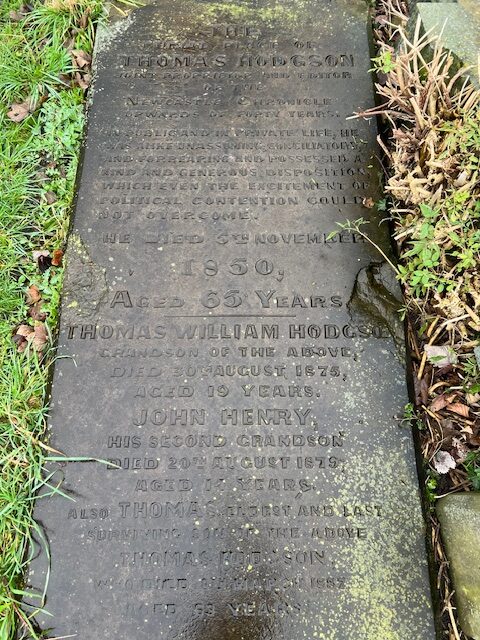
PROPRIETOR and EDITOR OF THE NEWCASTLE CHRONICLE
Situated in the Consecrated/South West of Jesmond Old Cemetery.
Thomas Hodgson.
The Newcastle Chronicle was founded in 1764, and published as a weekly broadsheet, by a Mr. Thomas Slack, a printer, and his wife Ann Fisher. The newspaper was first printed in Union Street, Newcastle, which was a group of ancient premises occupying the site of the Bigg Market, near the old Town Hall.
Prior to her marriage Ann established an evening school for young women who wanted to improve their literacy skills. She published “A New Grammar and Spelling Book” establishing her as the first female grammarian in modern English. There is a Plaque on the gate of St John’s Churchyard where they are buried.
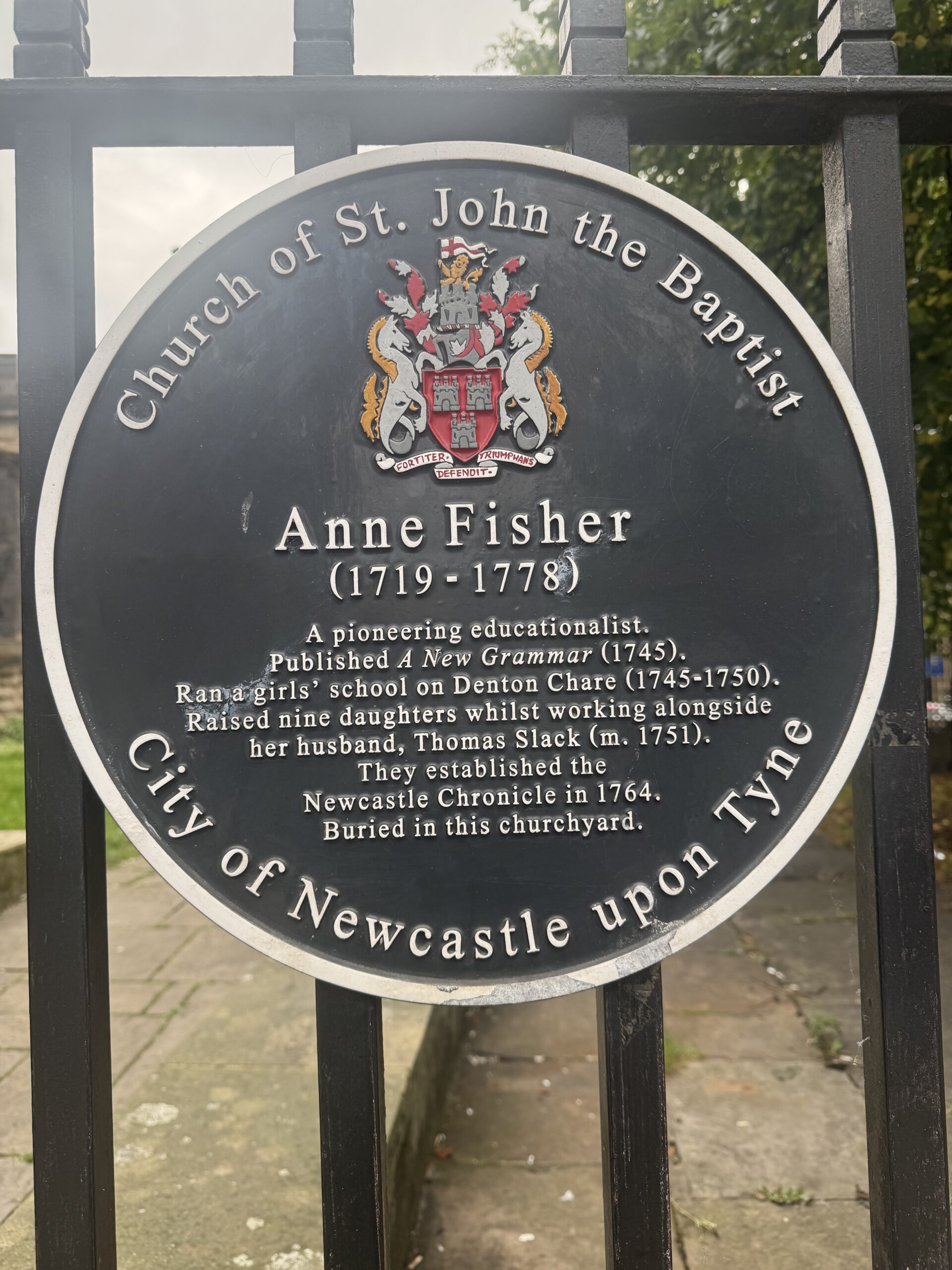
Together they had nine daughters – it must have been interesting house to live in. On the death of Thomas and Ann, the business passed on to one of the daughters, Sarah, in 1785. Sarah married a Mr. Solomon Hodgson and together they continued to run the business ‘with great enterprise and success’. Sarah and Solomon had three sons and two daughters; Solomon Joseph, who died at the age of 17, Hannah, who died two years later at the age of 27 and Sarah, who died aged 7. All three are buried alongside their parents in St. John’s Churchyard.
Of their surviving sons, Thomas, the eldest, was born on the 15th August 1785 and was baptised in St. Johns Church on the 9th November. James was born on 6th May 1793 and baptised on the 25th January 1794.
In 1794, Solomon sold off part of the business to his brother in law but after his death in 1800, Sarah bought back what had been sold and re established herself as the owner, running the business with her two surviving sons, Thomas and James. After Sarah’s death in 1822, they continued running the business; Thomas had been looking after the editorial side since 1806, when he reached the age of 21, and James, the commercial aspects since 1814, when he became of age.
Thomas married and had 3 sons; he can be found in the 1841 census living in Albion Street with his sons Thomas, Samuel and John. Thomas is recorded as being a ‘Printer’. In his later life he wrote a “History of the Stations on the Roman Wall with an account of the memorials discovered in them.”
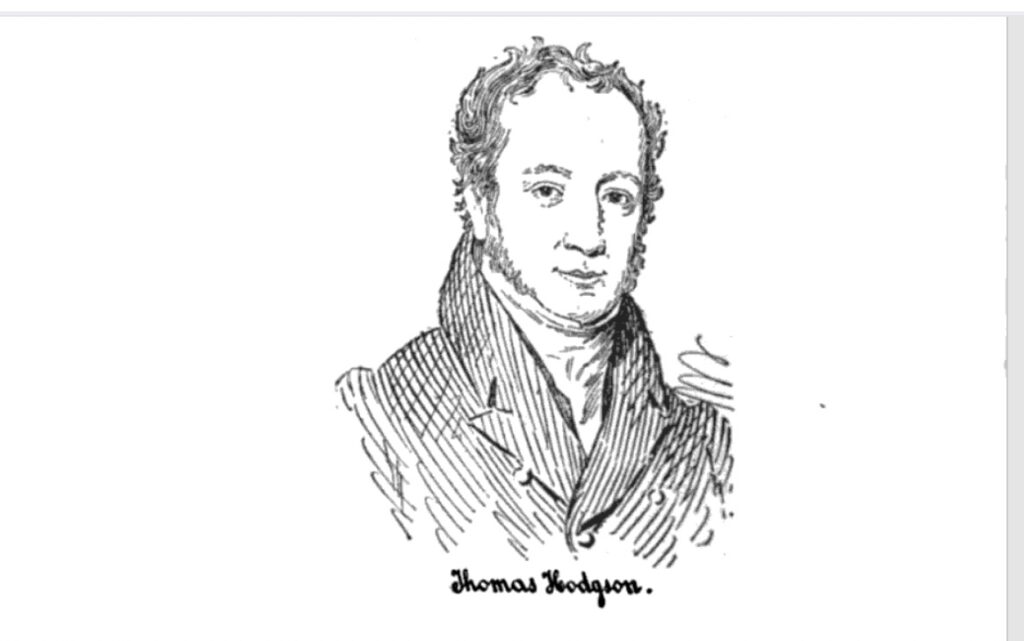
Thomas was an active member of the Newcastle Literary and Philosophical Society. As his health faded, he relinquished his duties as editor of the Chronicle and in January 1850 it was sold to Messrs. Lambert, Bourne and Bailey Langhorne. The printing office was removed from Union Street in May of that year and moved to Mr. Lambert and Partners’ establishment in Grey Street. Interestingly, the machinery was driven by hydraulic power installed by W.G. Armstrong and Co.
Thomas died on the 5th November 1850, aged 65, with his death being reported in the Newcastle Guardian on 9th November thus, ‘At his house, in Albion-street, on the 5th inst, aged 65, after a very protracted illness, Mr Thomas Hodgson, late one of the proprietors, and for upwards of forty Years, editor of the Newcastle Chronicle. In that paper of yesterday there is a graceful notice of the deceased, from which we extract the following:-“His editorial labours were marked throughout by the kindliest feelings; the asperity of party was to him a thing unknown, and amidst all the excitement of political strife, and even occasionally of personal contention, he ever maintained a high tone of gentlemanly feeling, never overstepping the bounds of fair and honourable discussion, or failing to treat either the opinions or feelings of others with courtesy and forbearance.
But, although his lot was cast upon the troubled sea of politics, it was a sphere which was far from congenial to his nature, and had he been at liberty to devote his high talents to the quieter pursuits of literature and science, his enlarged and comprehensive mind would have placed him high amongst the most eminent of the country. As it was, there were few subjects upon which he was not extensively informed; but his leisure had been more particularly directed to the study of Anglo-Roman Antiquities, on which subject many elaborate papers from his pen have, from time to time, appeared in the Transactions of the Antiquarian Society of this town, and he has left behind him an extensive collection of materials for a new edition of ‘Horsley’s Britannia Romana.’ In private life the late Mr Hodgson was distinguished for the warmth of his attachments, the kindness of his heart, and the same candour, sincerity, and mildness of disposition, which were so conspicuous in his public career.
Guile had no lodgement within his breast, and his memory is sure to be held in veneration by all who had any knowledge of him, and so long as the better qualities of our nature are prized and esteemed in the world.”